A Sacred Vessel on the Nile
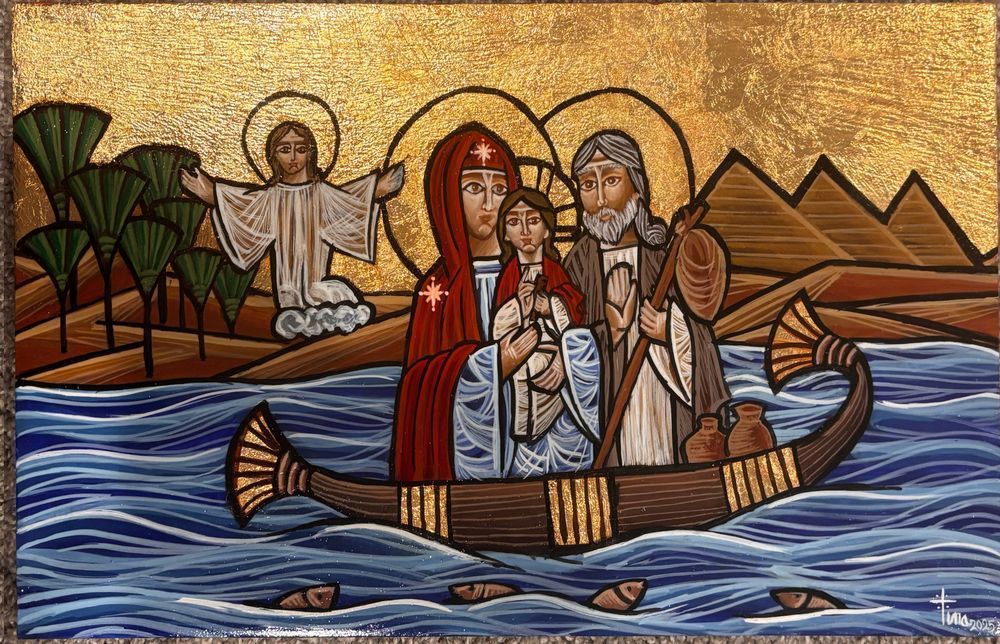
This remarkable Coptic icon, The Holy Family's Flight into Egypt, is a profound testament to the resilience of early Christian faith and its deep, symbiotic relationship with the land of Egypt. Painted in the classical method on a seasoned wood panel, the work immediately strikes the viewer with its vibrant, otherworldly palette and sophisticated narrative symbolism. It is not merely a depiction of a biblical event, but a visual homily on divine providence, the spread of the Gospel, and the sanctification of the Egyptian landscape.
At the heart of the composition, the Holy Family is seated within a gracefully curved boat, a design echoing the ancient papyrus skiffs of the Nile. This is a masterful theological choice. The boat becomes a symbol of the Church itself, carrying salvation and navigating the waters of the world.
-
The Theotokos, the Virgin Mary, is rendered in her traditional Coptic role as The mother of God. Saint Mary's garment in a deep ultramarine blue, a pigment historically more precious than gold, signifying her celestial nature and the truth of heaven. Her inner tunic is often a rich crimson, representing the earthly, human flesh from which God took form. Her posture is one of serene vigilance, her hand often gesturing towards the Child, the source of their salvation.
-
The Christ Child is held securely, a beacon of divine light. He is swaddled in garments of gold leaf, not merely a color but light itself, illuminating the scene and affirming His divinity. His gesture of blessing towards the river sanctifies the very waters they travel upon.
-
Saint Joseph stands as a protective, paternal figure behind them. He is typically dressed in the humble, earthy tones of ochre or sage green, symbolizing his humanity, his role as a carpenter, and his faithful stewardship. His attentive gaze often shifts between the family and the path ahead, embodying his role as guardian.
The background is a brilliant synthesis of geography and prophecy. On one bank, the iconic pyramids of Giza rise not as monuments of pagan power, but as silent witnesses to the arrival of the one true God. They anchor the story firmly in its historical Egyptian context. On the opposite shore, a grove of lush palm trees stands, their vibrant green fronds a symbol of resurrection, victory, and the life-giving sustenance God provided the Holy Family during their sojourn.
The River Nile, rendered in bands of turquoise and teal, is far more than a body of water; it is the River of Life. Its most captivating detail is the presence of four fish swimming in its currents. This is a direct and powerful symbol. The fish, an early Christian acrostic for Jesus (ΙΧΘΥΣ - Ichthys), represents the believers. The number four is universally symbolic of the Four Gospels—Matthew, Mark, Luke, and John. Thus, the iconographer presents a profound truth: as the Holy Family travels through Egypt, they are sowing the seeds of the Gospel, which will be carried by these "fish" to the four corners of the world.
The Artisan's Soul: Medium and Method
The power of this icon is inextricably linked to its medium. It is executed in tempera on wood, the venerable technique of the early iconographers. The Tempra technique, using egg yolk as a binder, allows for the application of luminous, layered colors that possess a unique depth and a matte, spiritual glow. The pigments are all derived from the earth: ground minerals, ochres, and precious stones, creating a palette that feels both ancient and eternal. The wood panel itself, often of a resilient native timber, is not merely a support but a part of the sacred object, its organic grain a subtle reminder of the Cross and the Tree of Life.
This icon is a masterwork of Coptic spirituality. It transcends a simple narrative to become a cosmic map of salvation history. The harmonious composition, the symbolic use of color, and the profound theological details woven into the landscape all speak to a deep and living faith. For the collector, it represents not only a beautiful artifact but a tangible connection to the enduring journey of the Church, carried safely, like the Holy Family, upon the waters of time. It is a piece that does not simply hang on a wall, but invites the viewer into a sacred space of contemplation and grace.